
The Claritas Letter
Moving from Chaos to Clarity
Identity Beyond Titles | 3-2-1
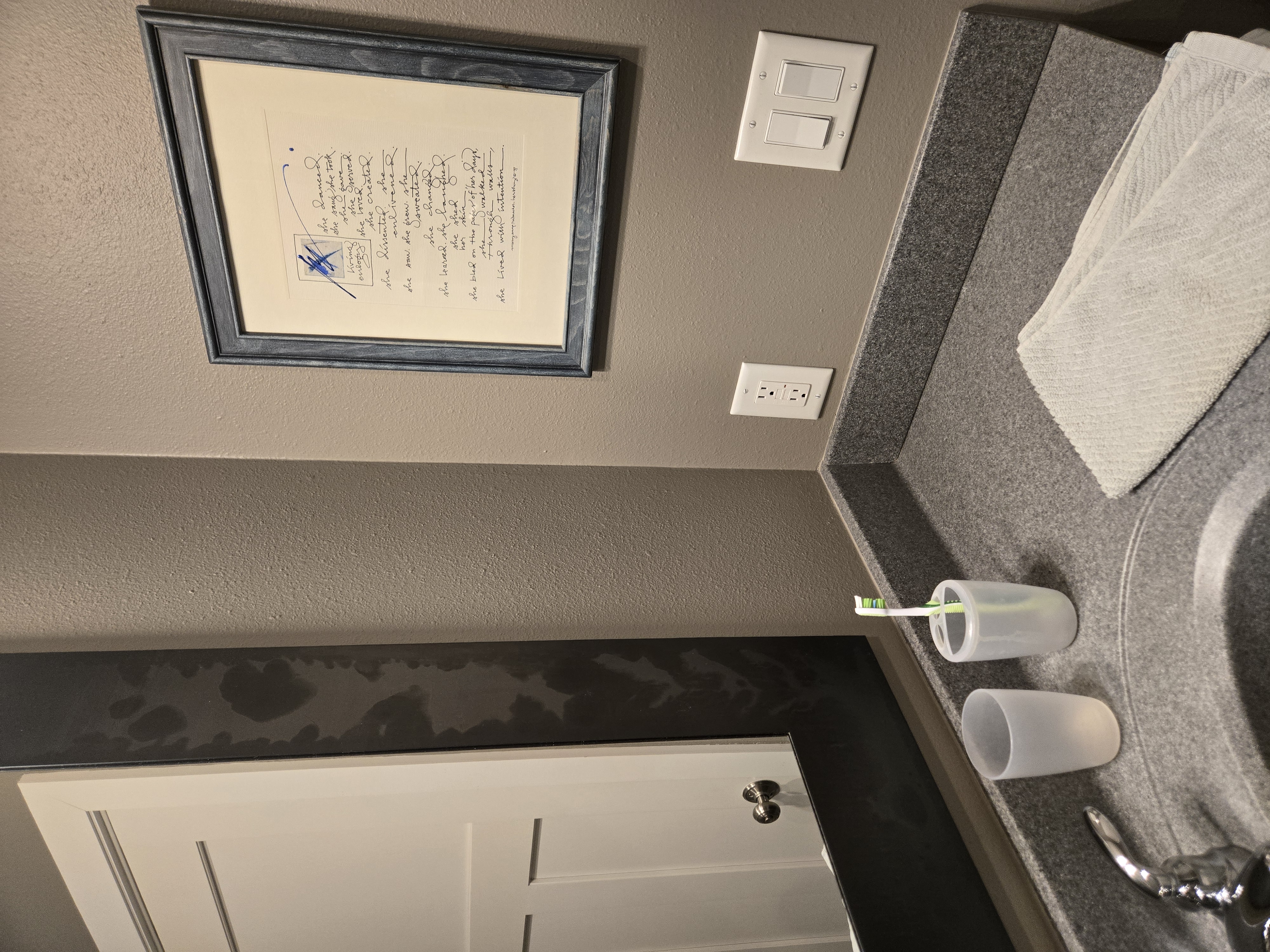
I read this poem every day.
Photo Credit: Lee Ann Lau
The View from Here
“I liked it better when you were a surgeon.” My daughter said this to me in February 2021, halfway through my palliative medicine fellowship. Her reason? It was harder to tell people what I did for work - most people recognize what surgeons do; palliative doctors, not so much.
I’ve been thinking about how much space my professional identity consumes in my overall identity. Who am I without my job title and professional accomplishments? This isn’t the first time I’ve thought about this. Over the years, I’ve read articles about how non-Americans find it strange that Americans always introduce themselves with their professional title - “What do you do” tends to come up very early in introductions. People talk about being counter-cultural, but attempts to bypass this script by talking about personal passions or hobbies usually results in awkward conversations. The default programming is deeply ingrained (and already obvious to 12 year olds!).
This month I dug in past the cultural default to look at how it directly impacts my behavior. As I explored the psychology of contingent self-worth, I learned that a good portion of my self-worth is contingent upon competency and success. While there are other domains of self-worth, this competency-contingency is a primary one for me (and many high-achievers). My desire to be competent and successful means I generally struggle to pause. The inability to pause is not driven by desire to succeed but by a fear of becoming useless or unvalued. Logically, I know the value of rest (see my April newsletter!). What has become obvious is how my own internal psychology keeps me from fully realizing the benefits. This month, I have implemented strategies with the specific intent of counteracting the contingencies in my self-worth. Modifying the cultural environment that creates the contingencies is not reasonable - changing my response is entirely within reach.
One strategy is to participate in activities that are process-oriented rather than goal-directed. I see that there are many process-oriented activities that I enjoy, but I see how my desire for constant productivity puts a spin on them as being productive, which can rob them of their joy. As an example, I love reading fiction and getting lost in stories, which doesn’t serve a specific goal. For many years, I deprived myself of this restorative joy because it was not a productive endeavor.
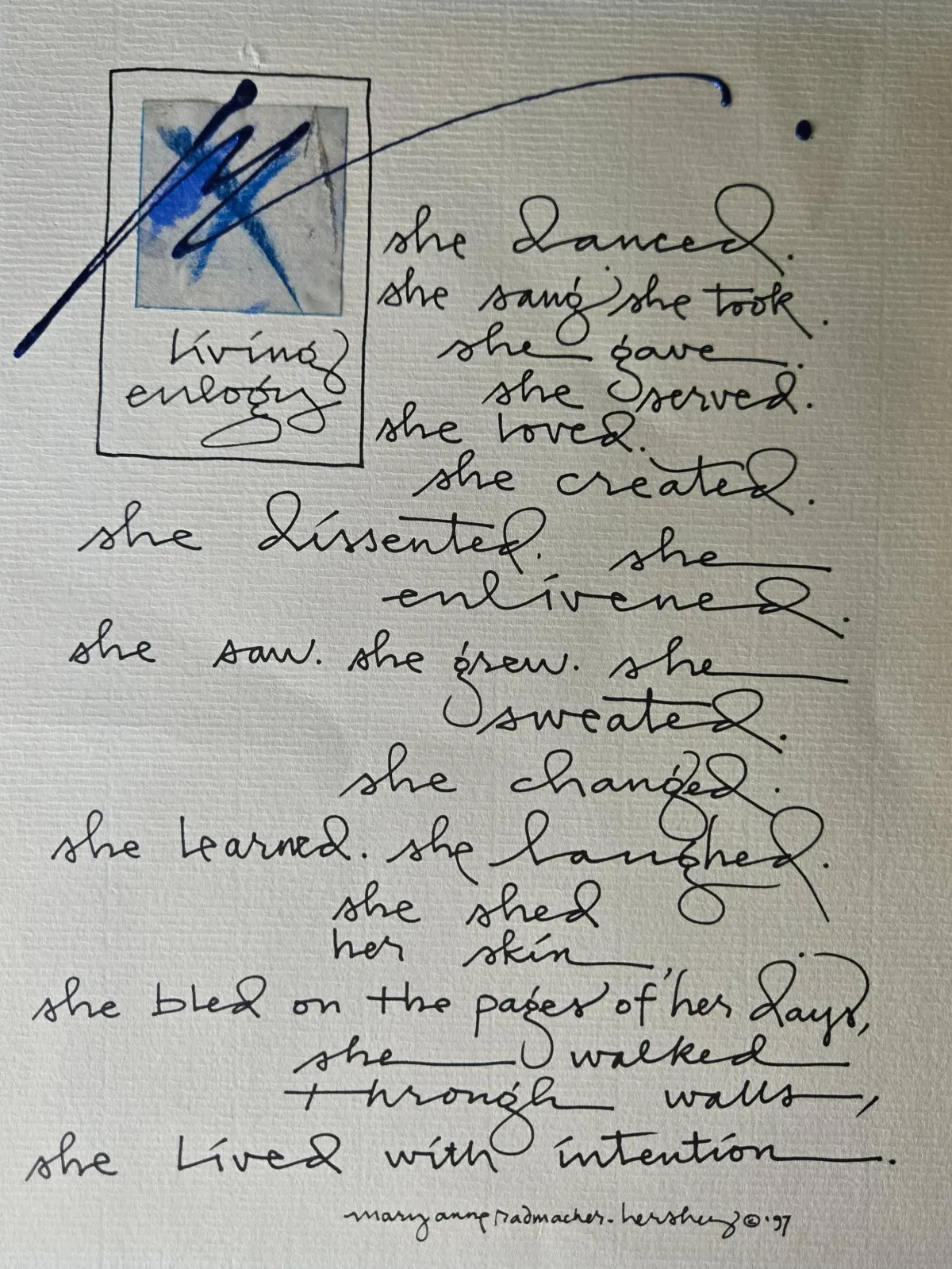
"Living Eulogy" by Mary Anne Radmacher-Hershey
Photo Credit: Lee Ann Lau
I have had the poem "Living Eulogy" by Mary Anne Radmacher-Hershey in my bathroom for decades. I've come to realize that she is describing the joy of the process of life, rather than the productivity.
Read more in this month’s in-depth article: “Who Am I Without the Job” to learn more details about self-worth contingencies, the science behind the supportive strategies, and the difference between telic (goal-directed) and atelic (process-oriented) activities.
LINK TO ARTICLE https://www.claritaslife.com/resources/the-compass/who-am-i-without-the-job
3 | Your Turn
If you couldn't use your job title, how would you introduce yourself?
What would happen if you engaged in an activity with zero intention of producing a measurable outcome?
Where are you interpreting a physiological need to pause as evidence of personal uselessness?
2 | Worth Your Time
Poem:
"Living Eulogy" by Mary Anne Radmacher-Hershey
This poem captures a lifetime of presence-driven moments, offering a grounding reminder to anchor our identity in the quality of our existence rather than our professional execution.
TED Talk:
This presentation details the psychological equation linking human value to continuous execution, demonstrating how the fear of failure forces high-performing professionals into a burden of inaction.
1 | The Lab
The Self-Compassion Break is a grounding five-minute practice providing space to combat our self-worth contingencies. By stepping through mindfulness, shared human connection, and genuine kindness, this practice quiets our harshest inner critic.
The Tool: Self-Compassion Tool
Where Clarity Meets Connection
Do you struggle with competency-contingent self-worth?
Let me know what resonated most with you!
To bridge the gap between where you are and where you intend to be, I created LUCA (Living Under Clarity & Alignment), my dedicated space for us to connect. It is a catalyst for your "right now".
Share a thought. Celebrate a breakthrough. Ask a question.
I personally review every message, and I’m here to listen.
Would you like to be on the mailing list and receive the Claritas Letter each month?
CHAOS to CLARITY
Your 12-Week Roadmap to Purpose
In the world of the busy professional, it’s easy to feel constantly overwhelmed, living a life dictated by external demands and the endless cycle of doing rather than being. If you've already tried to make major changes on your own without success, you know that strong intention alone isn't enough to break deeply ingrained habits. My program, “Chaos to Clarity: Your 12-Week Roadmap to Purpose", provides the proven framework, actionable steps, and consistent guidance necessary to move beyond simple motivation and build a truly sustainable life. For the busy professional tired of feeling trapped, I provide the clarity, support, and accountability needed to transform your life and live with a clear sense of purpose, starting today.
Book a free Clarity Compass Session
Copyright 2026-2027 © CLARITAS LIFE